Weekly Investment News
Weekly Funding Roundup: DeepTech Infrastructure and Scientific AI Scale-Up
This week's UK funding activity reveals a clear concentration of capital around AI infrastructure, scientific discovery platforms, and enterprise governance technologies. Investors continue to favour businesses solving the practical challenges of scaling artificial intelligence rather than simply building new application layers. Institutional investors are increasingly backing companies operating at the intersection of physical infrastructure, advanced computing, scientific research, and AI-driven automation.
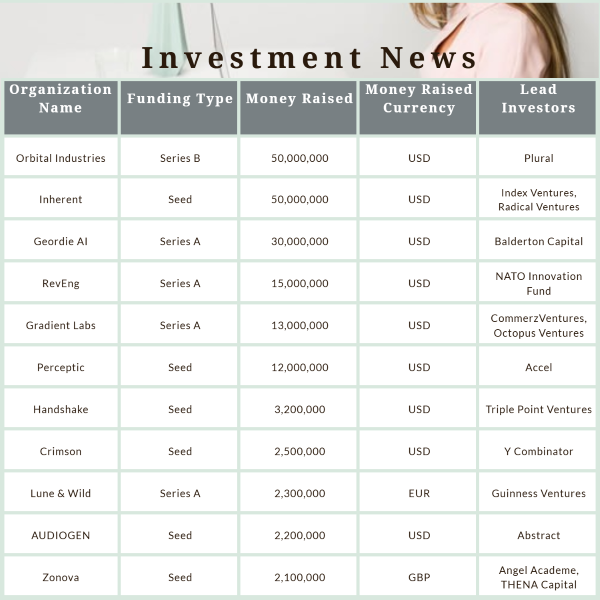
Below is a summary of the key organisations securing capital this week:
What This Week's Funding Signals
The layout this week aligns with structural shifts toward enterprise robustness, physical-layer constraints, and deep automated integration.
-
Deep Compute Infrastructure: Orbital Industries' $50M Series B highlights a critical scaling bottleneck in AI infrastructure. Investors are backing AI-engineered physical systems designed to address the growing demands of high-density compute, including PFAS-free dielectric cooling fluids and modular data-centre hardware that can be deployed rapidly as GPU demand accelerates.
-
Autonomous Agents & Scientific Workflows: The market is continuing its shift from AI "copilots" toward autonomous, workflow-executing agents. Gradient Labs is expanding its platform of AI agents that automate complex customer operations across regulated financial services environments, including customer support, lending, disputes, and KYC processes. Most notably, Inherent's $50M Seed round reflects growing investor conviction in AI-native scientific discovery platforms, with its Faraday system aiming to accelerate and automate elements of the research process through open-ended human-AI collaboration.
-
Compliance & National Security: Geordie AI's recent $30M Series A, following its RSAC Innovation Sandbox victory, reinforces the view that governance, visibility, and runtime safety for autonomous AI agents are becoming foundational enterprise requirements. This trend is further supported by RevEng's $15M Series A led by the NATO Innovation Fund, which is building a binary-level software verification platform capable of inspecting compiled software and identifying hidden vulnerabilities, malicious functionality, and software supply-chain risks.
Implications for Finance Leadership
This week’s funding activity reinforces a broader shift in capital allocation: investors are concentrating funding into businesses where execution risk, capital intensity, and regulatory exposure are all increasing in parallel. In this environment, access to capital is no longer the constraint — disciplined financial control is.
For CFOs and senior finance leaders, this translates into a materially more demanding operating model. Deep-tech, scientific AI, and regulated infrastructure businesses are characterised by long development cycles, high burn visibility, and complex milestone-based funding structures. As a result, finance functions are being required to operate closer to engineering, product, and regulatory stakeholders than ever before.
The differentiator at this stage is not traditional reporting capability, but the ability to translate technical progress into capital efficiency, maintain investor-grade governance under uncertainty, and preserve strategic optionality across multi-year build cycles.
At Harper May, we support investment-backed and scaling businesses across London and the UK in appointing finance leaders who can operate effectively in these environments. From deep-tech infrastructure platforms to high-growth AI and fintech organisations, we help build finance teams capable of supporting disciplined expansion and institutional-grade financial control.
Explore our specialised areas:
-
CFO Recruitment: Strategic leadership for VC and PE-backed firms.
-
Finance Director Recruitment: Operational excellence for scaling SMEs.
-
Finance Recruitment Services: Building high-performing finance teams in London.